Here, Erik of the Farpoint Farms YouTube channel explains how WATA-AM kept him and countless others informed after Hurricane Helene cut a path of destruction through western North Carolina.
“AM radio is often thought of as obsolete,” Erik writes. “I wouldn’t want to tell that to any of the tens of thousands that have relied on the info broadcast from this station for the past three weeks! Reach out to your local station and see if they need help staying on the air. many of these are mom and pop stations that are run by a single soul. When the time came, this station was ready to step up.”
Check out Farpoint Farms’ latest video above for recordings of WATA making a difference.
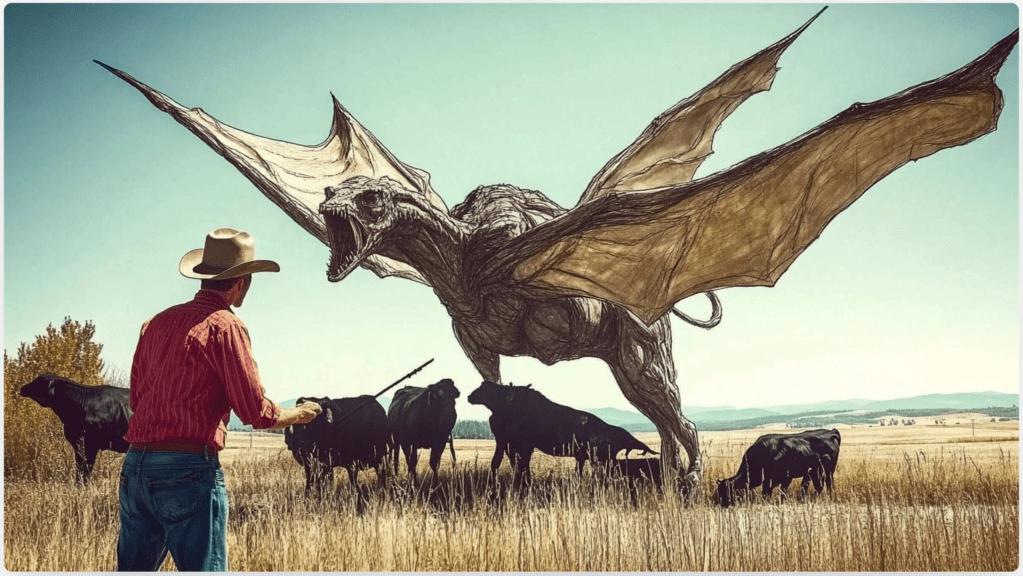
A fun feature of Midjourney is that even when it misses the mark, its efforts can be valuable for other projects. The image above seems to show how the famed “thunderbird” might have terrorized ranchers — and could find use in a Weird West idea I’m developing. For the record, here’s the prompt that generated this image…
Generate a primitive, hastily completed doodle sketch that a cowboy under hypnosis might create to illustrate seeing cattle abducted by extraterrestrials. Despite being an amateurishly created drawing, the images should look scary. This drawing should be shown on a ruled sheet of three-hole notebook paper. –ar 16:9 –v 6.1 –stylize 0 –weird 600
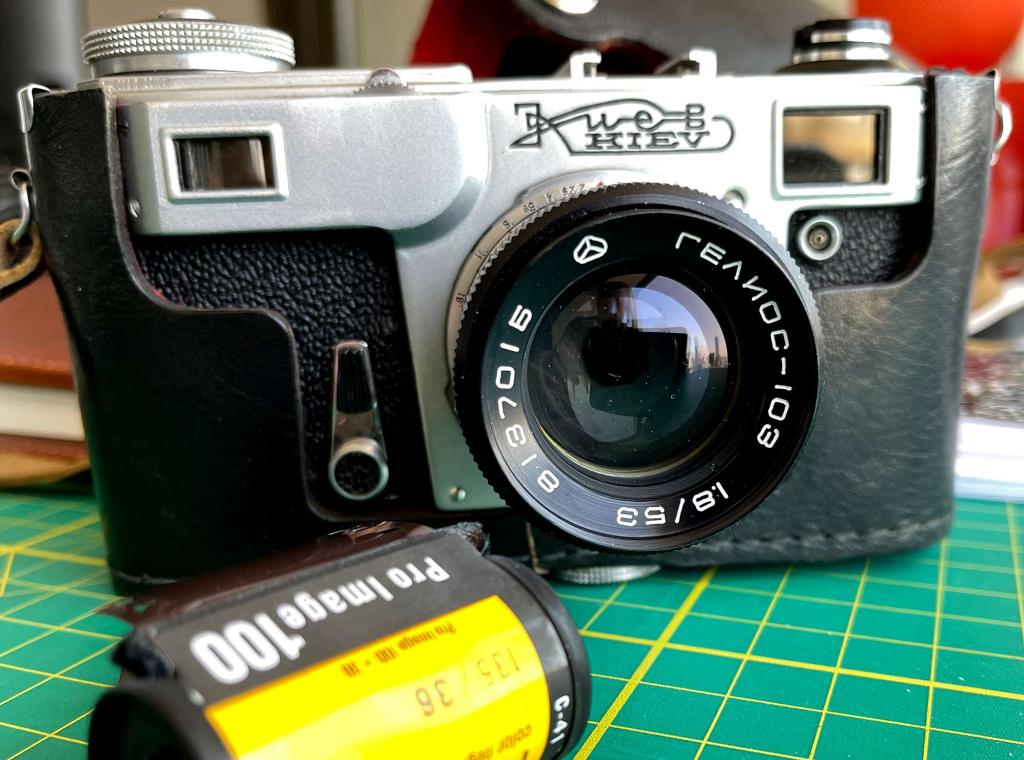
My Kiev 4AM rangefinder, fresh from Ukraine — and loaded with Kodak Pro Image 100.
I recently experienced the thrill of receiving a Kiev 4AM rangefinder camera shipped all the way from Ukraine. As a photographer, there’s something magical about acquiring a piece of history, and the Kiev is an exceptional addition to my collection.
The Kiev 4AM is not just any camera; it’s steeped in history. Based on the pre-World War II Contax rangefinder, the Kiev embodies a legacy of meticulous German engineering and post-war Soviet manufacturing.
After World War II, the Soviet Union acquired the designs and machinery from the Carl Zeiss factory, enabling production of the Contax-inspired Kiev cameras. Manufacture of these cameras continued until the 1980s, making them a fascinating blend of pre-war design and Cold War-era craftsmanship.
Unboxing the Kiev 4AM, I was immediately struck by its solid, mechanical feel. Unlike modern digital cameras, the Kiev is built like a tank, with a reassuring heft that speaks to its durability. The controls are mechanical and precise, offering a tactile experience that is increasingly rare. It’s no Leica M series, known for its legendary precision and elegance, but the Kiev has a charm and robustness all its own.
Eager to test my new acquisition, I loaded it with Kodak Pro Image 100, a film known for its vibrant colors and fine grain. I exposed three rolls and sent them off to The Darkroom for processing and scanning.
While the Kiev 4AM lacks the prestige or the price tag of a Leica, it offers a unique and rewarding photographic experience. The camera’s history, combined with its solid build and reliable performance, makes it a standout piece in my collection. It has quickly become a favorite, not just for its functionality, but for the sense of connection it provides to the rich history of photography.
I look forward to many more rolls of film and countless photographic adventures with my Kiev 4AM.
Here’s one of the few good images I managed to coax from a Holga 120GCFN medium-format camera.
As someone who has experimented with various cameras, my experience with the Holga 120 has been disappointing. Despite its cult following, I’ve never gotten reliably consistent results from any model I’ve owned. It baffles me how people can be in love with this camera.
The Holga 120, introduced in China decades ago, was designed to target the country’s vast consumer market. Surprisingly, the poor-quality images this camera produces didn’t spark another cultural revolution. The design is meant to be simple and affordable, but it meets those goals at the expense of quality. None of the images I’ve taken with the Holga are printable or digitally usable without extensive work in Photoshop.
One of the most significant issues I’ve found is the camera’s inconsistency. One roll might come out somewhat decent, and the next, a complete disaster. Light leaks, focus problems, and scratched film are a few of the recurring issues.
The camera’s plastic lens, while charming to some for its vignetting and blurring effects, often results in more frustrating than artistic images. Even the “premium” Holgas with glass lenses don’t cut it.
A particularly disheartening experience was with the Holga stereo camera. I had an assignment to shoot event photos and decided to use this camera to capture 3-D images, adding an exciting dimension to the project.
Before the event, I shot two test rolls that came out perfectly, which gave me false confidence. On the night of the event, however, things went awry. One or both lenses intermittently did not work, making fewer than a third of the images usable.
Naturally, these defects weren’t apparent until the photofinisher returned the film and scans.
This was embarrassing because the event organizer and I had distributed anaglyph glasses to attendees, promising them the thrill of seeing themselves in glorious 3-D on a website. Instead, I spent hours in Photoshop trying to salvage what I could from the usable images. Despite my best efforts, the final product was far from the stunning 3-D experience we had envisioned.
The Holga’s unpredictability and the amount of post-processing required make it a tool more suited for hobbyists looking for a whimsical challenge rather than advanced amateurs or professionals needing reliable results. While some may argue that the Holga’s flaws are part of its charm, I find them deal-breakers.
It’s not that I don’t appreciate the unique aesthetic the Holga can produce — when it works. The problem is that it rarely does so consistently. Amateur or professional photography requires a certain level of dependability that the Holga can’t deliver.
While the Holga 120 camera might have a niche appeal for those who enjoy its quirky, unpredictable nature, it falls short for anyone seeking consistent results. My experiences with this camera have been marked by frustration and disappointment, and I can’t understand the adoration it receives.
If you’re considering a Holga, be prepared for a lot of trial, error, and post-processing. For me, the Holga’s charm has long since worn off.
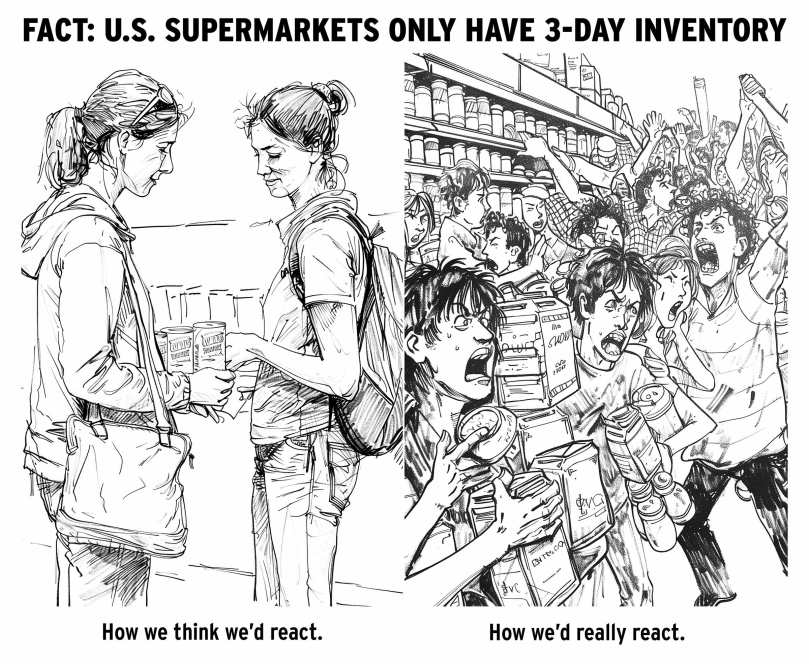
The U.S. food supply chain, often perceived as robust and unshakeable, is far more fragile than many realize. Supermarkets typically hold only a three-day inventory of food. This revelation has raised concerns about what might happen if the food supply were to be disrupted.
The “just-in-time” nature of the food supply chain means that stores receive frequent shipments to keep shelves stocked, minimizing storage costs and reducing waste. However, this efficiency comes with significant risks. If any link in the chain — ranging from farms to processing plants to transportation networks — experiences a disruption, the impact can be felt almost immediately in grocery stores.
A disruption could stem from various sources. Natural disasters like hurricanes or earthquakes can devastate local supplies and cripple transportation routes. Even more insidious are the potential impacts of a major cyberattack or a pandemic resurgence. During the COVID-19 pandemic, for example, labor shortages at every level — from farm workers to truck drivers — led to noticeable gaps on supermarket shelves and soaring prices.
Jamie Lutz from the Center for Strategic and International Studies (CSIS) points out that the pandemic caused a significant strain on the supply chain. Increased demand from consumers, who turned to home cooking during lockdowns, combined with labor shortages due to illness, exacerbated the situation. The result was a sharp rise in food prices, making it harder for families to afford basic necessities.
Toby Hemenway, an expert on food security, explains that while the food system is indeed complex and adaptive, it’s also highly interdependent. This interdependence means that a disruption in one area can cascade through the system, causing broader impacts. He suggests that localizing food production and diversifying supply chains could help mitigate some of these risks. Hemenway argues that storing vast amounts of food in urban areas is less effective than ensuring a steady flow of goods through a resilient and flexible supply chain.
If a severe disruption were to occur, supermarkets could run out of food in just a few days. This would lead to panic buying and hoarding, further exacerbating shortages. Vulnerable populations, such as those relying on Supplemental Nutrition Assistance Program (SNAP) benefits, would be particularly hard hit. The federal government attempted to address these vulnerabilities by temporarily increasing SNAP benefits during the pandemic, but these measures are short-term solutions to a long-term problem.
While the U.S. food supply chain is designed for efficiency, its lack of redundancy makes it vulnerable to disruptions. Preparing for these potential crises involves not only improving the resilience of the supply chain but also encouraging local food production and ensuring that all communities have access to emergency supplies. The complexity of the system requires comprehensive strategies to protect against the myriad threats that could lead to empty shelves and widespread hunger.
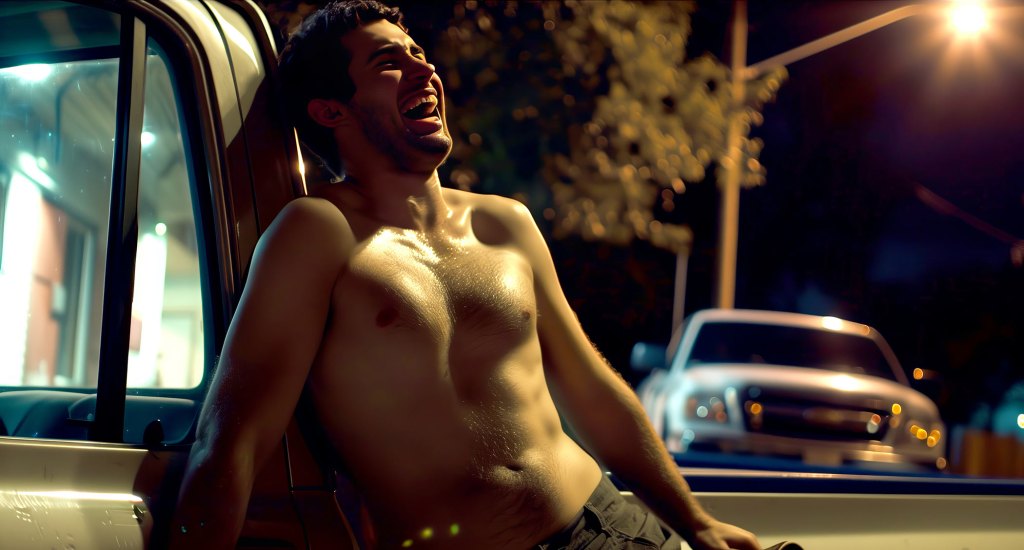
I stumbled down the residential street, my mind a kaleidoscope from the ‘shrooms. The cool night air felt electric, and I felt invincible.
Danger? No way. Fuck it!
A house caught my eye. I banged on the front door until the glass shattered. A family, perched on a sofa, shifted their gaze from Netflix to me.
I shed my clothes, reveling in the freedom. Get a load of this, you stinking normies!
Then, headlights, blue lights, red lights, and cop voices flooded the street. I swung a machete over my head and dove into the bed of a pickup parked in the driveway.
Machete? Where the fuck did I get that?
Johnny Law dogpiled me in seconds; a burly officer knocked my blade aside. I tore the left-side mirror from the truck as the cops wrestled me to the concrete.
At the hospital, I ripped out four IVs before orderlies strapped me to an exam table. The sedatives took hold, and my world faded to black.
The next day I awoke puking in a County Detention Center holding cell. Maybe running around naked and terrifying a family hadn’t been the best way to party.
Use your preferred art supplies to colorize this warning.
The impending subjugation of U.S. sovereignty by the United Nations and FEMA is a plot of unparalleled magnitude. FEMA camps will become detention centers for dissenters while the UN’s blue helmets enforce a tyrannical regime. Still cloaked in secrecy, this nefarious scheme threatens to plunge our nation into a dystopian nightmare where liberty is a distant memory. The hour is dark, and resistance is imperative.
Look for “Agenda 21 Comes to Colorado” this summer. It’s a coloring book. It’s a graphic novel. It’s a warning.





 L.T. Hanlon